

When you want to go hiking in a foreign country, travelling by public transport can be pretty useful. You may not want to leave your (rental) car at the trailhead unsupervised and unused for days. Besides, buses are often faster and run more frequently than trains. Also, some routes are just super gorgeous. I love the journey south from Brasov over the Rucar-Bran pass, and the super scenic route from Deva to Petrosani. In a past post I explained how to travel by train in Romania; now let’s talk about buses.
Although I love travelling by train in Romania, the train doesn’t always get you exactly where you want to be. Travelling by bus offers a wealth of other options! Trains don’t always stop exactly where you want them to, whereas buses go to almost every corner of the country. However, finding out which buses go where and when can be tricky. So here is your ultimate guide to travelling by bus in Romania. This post focuses on ‘intercity’ and ‘interstate’ bus travel; I’ll dedicate a separate post to public transport in cities.
Long-distance bus travel
The most important thing you need to know about bus travel is that you can find most bus connections on Autogari.ro. Please note that I just wrote ‘most’: not all operators update and upload their schedules regularly and hence, sometimes you get presented with outdated and inaccurate results. Also, some buses are not listed at all. Further up, I will suggest some strategies to double-check information on Autogari.ro. I can already tell you that travelling by bus in Romania is a bit of an art. Let me explain how to go about it!

Finding a bus
Like I said, to get an overview of available buses you should go to Autogari.ro. Enter your place of departure, destination, date and number of passengers, and click ‘Search’. On the next page, click on ‘Details’ under the bus you’d like to take. It’s essential you find out exactly where the bus departs from! Bigger towns usually have multiple bus stations, and in smaller towns or villages there may not be a bus station at all – buses may instead depart from the parking lot of a gas station, for instance. The departure station is right next to the place of departure. Clicking on it takes you to a page with the address of the bus station or stop. Pin this location in Google Maps or whichever app you use. This method is not 100% foolproof though; I’ve had a few occasions where the bus departed from a different location than the one stated on Autogari.ro. So if you want to be absolutely sure, the best thing is always to call the bus company. If you’re travelling during the weekend, call the operator before the weekend.

Buying a ticket online
If you’re in luck, you can make a reservation online. If this option is available, you will see a ‘Buy ticket’ button next to your bus of choice. This will take you to Bileteria.ro. You can also go straight to Bileteria.ro, but in that case you won’t see the buses that do not offer online reservations.
- Enter your details or create an account
On Bileteria.ro, enter your details or create an account for future use. Double-check your phone number and include the country code; the bus driver may need to call you to confirm your reservation or inform you about delays.
- Add passengers and choose seats
You can add multiple passengers by clicking the ‘Adauga calator’ button and choose your seat(s) under ‘Locuri’, if applicable.
- Add a return journey (if applicable)
- Pay by card
You can pay by credit card (use the ‘Netopia Payments’ link).
- Download your ticket
After payment, you will receive your ticket as a pdf file on your confirmation screen and in your inbox. It’s usually not necessary to print your ticket; just show the voucher to the driver. Although there are some drivers who habitually complain if you don’t print your ticket; but they’ll let you get away with it.
You can also choose to buy your ticket directly from the company you are travelling with, if they have their own website and reservation module. This is the case with Trans Olteanu Tour and Normandia, for instance.

Making a reservation over the phone
Not all bus companies offer online reservations; in many cases you’ll need to call an operator. If this is the case, call the number displayed in the blue box on Autogari.ro. If no number appears, click ‘Pagină operator’. For long-distance rides on buses that only go once or twice a day, I definitely encourage you to make that call, and not just turn up at the bus stop. You really don’t want to find out that there are no seats left! Or have someone make the call for you in case the dispatcher does not speak English – more often than not this will be the case. Long-distance buses are popular and tend to get fully booked. Also, often buses are small. You can see which type of vehicle to expect on the search results page. If making a reservation over the phone, specify which bus you want to take in case there are multiple departures per day, and ask where exactly it departs from and at what time; this may differ slightly from the info you find on Autogari.ro. You won’t need to pay ahead.
Buying your ticket from the ticket desk or driver
If you’re only planning to cover a short distance and see that many buses cover that trajectory (from Cluj to Turda for instance), it suffices to turn up at the station well on time and buy your ticket there. Each bus company may have its own desk. Do bring cash, since you may not be able to pay by card. Sometimes there is a ticket desk (birou de miscare), sometimes there isn’t, in which case you’ll have to buy your ticket straight from the driver. Asking around (or calling ahead) is the best way to find out which applies. I’m sorry I can’t be any clearer – this is simply the way bus travel works in Romania. It’s a very segmented market and you’ll just have to navigate your way around it. This post should give you some cues though!

Buses that do not appear on Autogari.ro
There are a great many local mini buses that do not show up on Autogari.ro. This is the case with buses from my nearest town, Orastie, to my village and other surrounding villages, for instance. The only way to find out about them is to go to the bus station and find an accurate timetable there, or ask the driver. As someone once succinctly pointed out, ‘Romania is very much an offline country’! Sometimes, buses that do not appear on Autogari.ro can be found online elsewhere, but require some googling. This is the case with buses from Petrosani to the towns in the Jiu Valley; an important access road if you want to go hiking in the Retezat Mountains. You can find these buses, operated by ZMK Transport, here.
Airport buses
If you want to take a bus directly from or to the airport, you have several options, most of which can be found on Autogari.ro as well. Some of these are shuttle buses that operate between one town and one airport several times a day; others are long-distance buses that also happen to stop at airports. Here is a non-exhaustive list of companies that serve airports; there are others which you can find on Autogari.ro but I don’t have experience with all of them, so I’ll restrict myself to the ones I know.
Trans Olteanu Tour serves four airports on their various long-distance routes: Timisoara, Sibiu, Targu Mures and Brasov. Use Autogari.ro to find out whether they depart from your place of departure.
Direct Aeroport operates a shuttle bus from Bucharest Otopeni Airport to Brasov city centre, as well as various other connections from smaller airports. You can also arrange a private transfer with them. Not always as reliable as I’d like them to be, and it can be a bit of a hassle to find the bus at Bucharest Airport. Drivers often don’t speak English, but will call you ahead of departure to make sure you are on board and guide you to the bus if necessary. See website for schedule.
M & M Express is probably the best service around when it comes to airport transfers. They offer hourly shuttle buses between Brasov and Bucharest Otopeni airport 24/7. You can also arrange a private transfer with them. This comes with a price tag, but it will get you to your destination fast and communication with them is always smooth. Drivers always speak English. See website for schedule.

Tourist buses
A special category are tourist buses. There are not many that I know of, but the following two services definitely deserve a mention.
Balea Bus is a tourist transfer service between Sibiu and the Transfagarasan Road offered and operated by Carpathian Travel Center. This is a great service if you want to go hiking in the Fagaras Mountains and start at a high altitude – or just do a short day hike around Balea Lake. You must make a reservation online. Tickets cost €35 for a single journey and €65 for a return journey (to be made on the same day). Operates June-September, depending on snow conditions on the Transfagarasan Road. See website for schedule.
Unesco Bus is another service offered by Carpathian Travel Center. It is a convenient transport service that makes it easy to explore the Transylvanian Highlands (Colinele Transilvaniei Ecotourism Destination). It connects top attractions between Sibiu, Sighisoara, and Brasov. The minivans follow a specific route with stops near major attractions. You can hop on at any designated stop, visit the attraction you’re interested in, and hop back on when you’re ready to continue. There are three curated routes. You pay €45 for a day pass or €80 for a two-day pass (discount for children). Tickets can be bought online. Buses don’t run every day and only in season; see website for schedule.

Recommendations
Here are some tips & tricks for travelling by bus in Romania I have learned over the years.
Double-check information found online
By now you may have gleaned it doesn’t do harm to make sure you have plenty of time on your hands when travelling by bus, to prevent unwanted surprises. Double-check the location of the bus station in advance; sometimes the location information on Autogari.ro is inaccurate. So even if you can buy a ticket online, you may still want to make that call to the operator to verify the departure time and location.
Don’t carry crazy amounts of luggage
On most if not all buses, you’re allowed to carry at least one large item of luggage. In practice though, the smaller buses and mini vans don’t have a lot of space for luggage. I’ve never run into trouble with this, but just don’t overdo it on the luggage front. You should be OK carrying a large backpack or suitcase. And you may be surprised at what the locals carry onboard… Good to know: many bus stations have a sala de bagaj (luggage storage). So if you want to head into town for a bit without dragging your suitcase around, you can often leave it at the bus station for a few hours, most likely against a small fee.
Ask the bus driver to drop you off where you need to be
Especially if travelling with a smaller bus, the driver may be happy to drop you off where you need to be, rather than the designated bus stop. Please be aware that this doesn’t work for all drivers; some are on a tight schedule and other buses are simply too big to stop just anywhere. But you can always try.
Transfers
You may not always be able to find a direct connection and may need to transfer. Bear in mind that your connecting bus may depart from a different bus station! You may need to walk some distance or take a taxi. If you can’t find a good connection, consider combining a bus and a train. This will require some creativity and research but is often well worth it and may save you a lot of time!
Bring cash
You may not be able to pay by card at all bus stations, so come prepared and bring enough cash for your tickets, some snacks and perhaps a connecting taxi to get you to your final destination. Taxis are often waiting for customers outside bus stations.
Stay safe
Keep your valuables on you at all times. Wear your seatbelt if you can – although you will find that they are not always in place. All buses have an obligatory notice in the front telling you to wear your seatbelt, but in practice virtually no one does. Which doesn’t mean you shouldn’t either! Romanian roads are not among the safest, so better safe than sorry – whatever the locals do.

Take your time
Take your time to get to the bus station and find your way around it, and buy some supplies for the journey. No bus station is complete without one or more small shops and bars. Bus stations are great places to immerse in important aspect of Romanian society. You may find yourself surrounded by men eating sunflower seeds, ladies in hats carrying bags of cake, peasants carrying produce to the market, and your everyday teenager texting or swigging energy drink.

Vocabulary
Here’s some vocab that might come in handy while travelling by bus in Romania:
Bus
Autobuz
Coach
Autocar
Mini bus
Microbuz
Bus station
Autogara
Bus stop
Stație
Ticket
Bilet
Journey
Călătorie
Driver
Șofer
Seat(s)
Loc, locuri
Reservation
Rezervare
One ticket to Sibiu, please.
Un bilet la Sibiu, vă rog.
Two tickets to Sibiu, please.
Două bilete la Sibiu, vă rog.
Reliable bus companies
Some bus companies are just better than others. Much of the fleet isn’t exactly state of the art and not all companies are equally punctual. I’ll just mention a few companies that I use regularly and am happy with. Normandia is a large operator which is always reliable, allows online reservations and has mostly big coaches. Trans Olteanu Tour has small vans with AC and works on the basis of reservations only; the driver will call you ahead of time to let you know if there are any delays and confirm you are still travelling. It’s a bit more pricy but it’s fast and comfortable. Of course, which companies are available entirely depends on your route. Likewise, there are really bad companies. For instance, I will never take the Polosam bus from Brasov to Sibiu ever again. Like an enraged fellow passenger complained the one time I did – ‘a horse and cart would do better!’. Buses on Autogari.ro can be reviewed, so if you want to know what previous passengers think, be sure to check out the reviews. You can also see whether a bus turned up or not in the past.
Travelling by bus in cities
Travelling by bus in Romanian cities is a whole different chapter. But a much easier one, fortunately! Many Romanian cities, including Cluj, Sibiu and Brașov, have an excellent public transport system in place that is easy to navigate. I’ll dedicate a future post to public transport in cities. For now, I wish you bon voyage – or Călătorie plăcută as the Romanians say!
Let me book your buses for you
Don’t want any hassle? Let me book your buses and trains for you! I can do this against an hourly fee of €60 (and I promise I’ll be fast). Fill out the contact form to find out more.
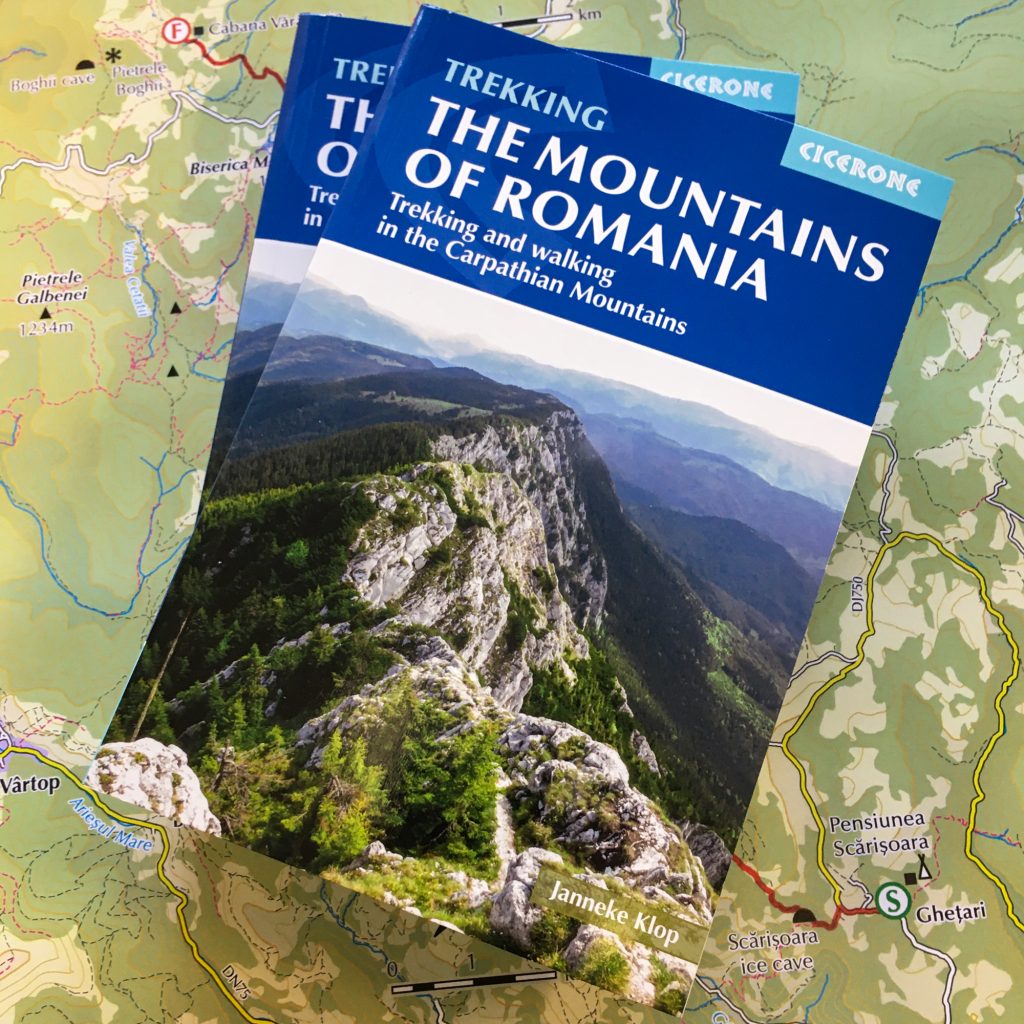
Buy my guidebook!
Are you planning to go hiking in Romania? You might want to buy my guidebook, ‘The Mountains of Romania‘! It offers 27 multi-stage treks and 10 day hikes all over Romania. It contains an extensive description of each hike, lots of practical info, overview maps, an accommodation appendix, a language guide, and comes with free gpx files. There is an e-book version as well! This is a project that I put my heart and soul in; I’d be so chuffed if you bought it! If you buy it directly from the publisher I get 10% royalties. You can also buy it directly from me; drop me a line here.
Like what you’re reading? Subscribe and receive an email notification for each new blog post.